
 |
|
|
|
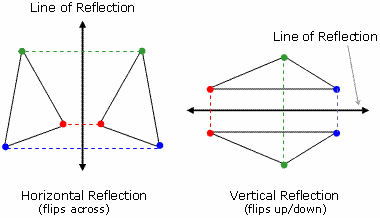
Basic Transformation GeometryFor transformation geometry there are two basic types: rigid transformations and non-rigid transformations. This page will deal with three rigid transformations known as translations, reflections and rotations.
In short, a transformation is a copy of a geometric figure, where the copy holds certain properties. Think of when you copy/paste a picture on your computer.
The original figure is called the pre-image; the new (copied) picture is called the image of the transformation. A rigid transformation is one in which the pre-image and the image both have the exact same size and shape.
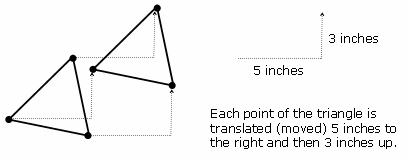
The most basic transformation is the translation. The formal definition of a translation is "every point of the pre-image is moved the same distance in the same direction to form the image." Take a look at the picture below for some clarification.
Each translation follows a rule. In this case, the rule is "5 to the right and 3 up." You can also translate a pre-image to the left, down, or any combination of two of the four directions.
More advanced transformation geometry is done on the coordinate plane. The transformation for this example would be T(x, y) = (x+5, y+3).
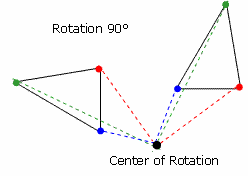
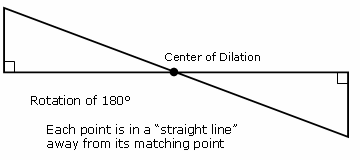
A rotation is a transformation that is performed by "spinning" the object around a fixed point known as the center of rotation. You can rotate your object at any degree measure, but 90° and 180° are two of the most common. Also, rotations are done counterclockwise!
Some geometry lessons will connect back to algebra by describing the formula causing the translation. In the example above, for a 180° rotation, the formula is:
This type of transformation is often called coordinate geometry because of its connection back to the coordinate plane.
Return to the top of basic transformation geometry. Return to more free geometry help or visit t he GradeA homepage. |

Stay connected
|
||

| . | ||
| Home │ Site Search │ Math Help Blog │ Help Keep GradeA Free | |
Written by Team GradeAmathhelp.com, all rights reserved. | ||