
 |
|
|
|
Combining Like TermsBefore you start combining like terms, you first need to know what the meaning of a like term really is. First, you need to know that a term is a number, or a number and a variable multiplied together. Terms are separated by addition and subtraction signs (+ and -). Examples of terms: (assuming our variable is x) x, 3x, 9, 6x2, -2x, 14, 8x3, -6, 2x2, 7x, -x2, 31 Each term above is either a number, or a number times a letter. The letter may also have an exponent. Definition of Like Terms: Terms that have the same variable raised to the same power.
More examples of unlike terms are below...
Beginning level algebra will only deal with 3 different groups in 1 variable:
By following these color patterns, it will make combining like terms much easier at the start. You can add different variables and higher powers once you get more familiar with the concept
Expression: A set of terms separated by + and - signs.
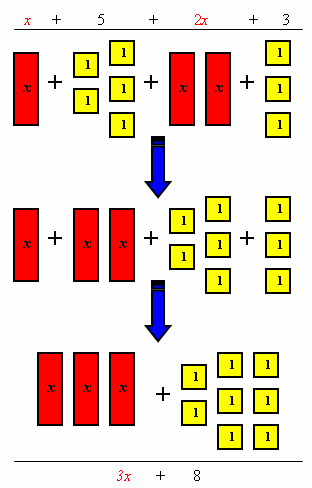
Look at the expression at the right: x + 5 + 2x + 3
Reorder (commutative property): x + 2x + 5 + 3
Combine the different groups: 3x + 8
Pictorial Explanation:
|
Stay connected
|
||

| . | ||
| Home │ Site Search │ Math Help Blog │ Help Keep GradeA Free | |
Written by Team GradeAmathhelp.com, all rights reserved. | ||